Why Wall Street and Silicon Valley are both wrong about SpaceX
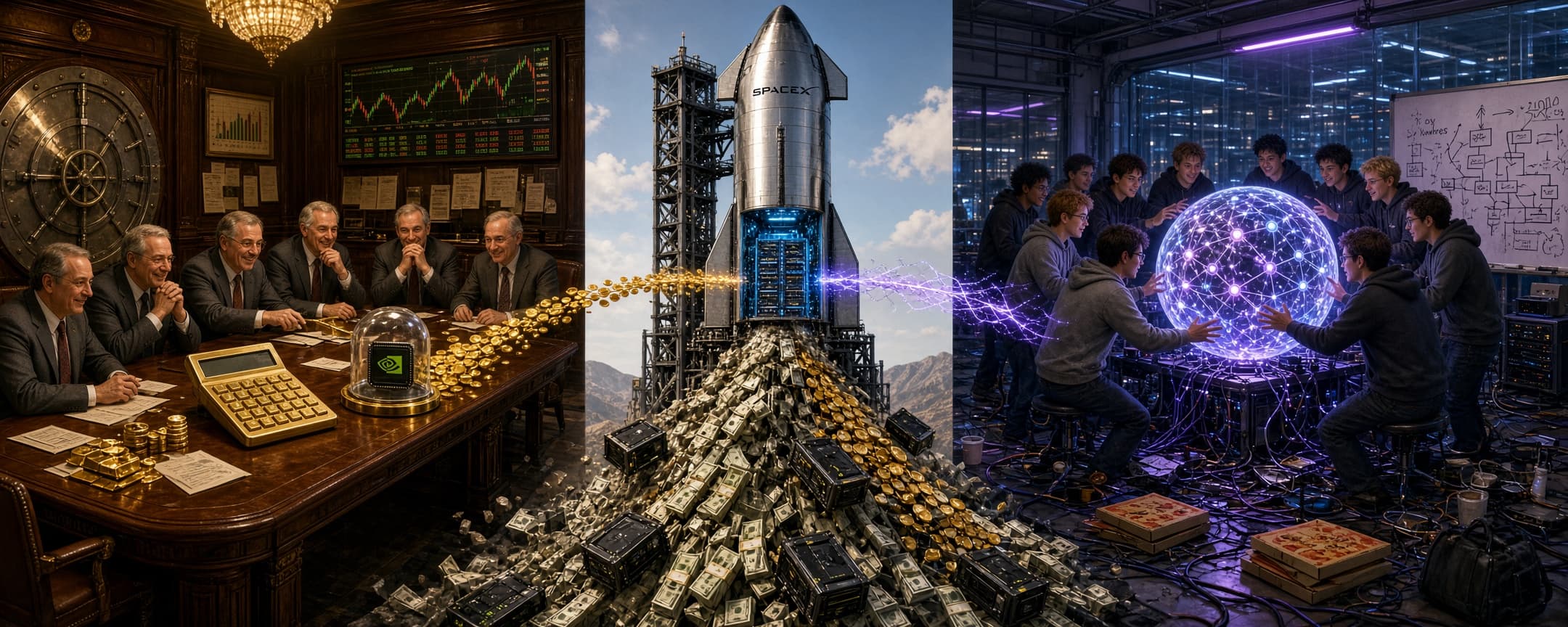
Wall Street only cares about ROI
Silicon Valley only cares about smarter models
I think both sides are right and both are wrong. You get scaling laws through ROI.
Wall Street
ROI is the only thing that matters, because that is the only way you get paid, promoted and achieve success on WS.
To get reliable ROI you need great risk adjusted returns, which is why they have been so skeptical of AI until the start of this year - when you saw Opus 4.5 start to do measurably productive work (a lot of slop tbf) - and you were able to see in the horizon that these models (and therefore also data centers) could be revenue generating assets for the labs.
Now the capital is in full flow, just look at the $500 billion NVIDIA is raising with Apollo, BlackRock, Blackstone, Brookfield, Goldman and KKR is Wall Street admitting that compute is an asset class.
Silicon Valley
Scaling laws say that if you train a model on more compute then the model gets better.
Their idea is that you can just scale, build a better product and revenue will come. Tbf this has been the case so far, Anthropic will 10x revenue this year and OpenAI is starting to accelarate again.
Nothing shows that better than what Sam Altman on David Senras Podcast: "Most of my effort right now is on research and compute. The most important thing that we can do is to create smart models and to be able to run them efficiently and abundantly for a lot of people. If we can get that right I believe that everything else will follow."
You get Scaling through ROI
If you stand up the cluster cheaper and faster, the ROI comes sooner, and that cash is what you can spend on the next compute cluster.
It's like a tiny snowball pushed down a mountain that starts by picking up just a few flakes. As it rolls, its growing surface area grabs more snow with every turn, transforming it into a massive, unstoppable avalanche.
that summarizes my entire point, SpaceX is the fastest (and therefore soon the biggest) snowball
They built Colossus 1 in 122 days, trained Grok 3 and 4 on it, and now is renting it to Anthropic for $1.25 billion a month ($15 bil ARR). If the ~$12.9 b capex is right, $15 bil in and maybe $0.8 bil cash out for power and ops then it leaves $SPCX with ~$14.2 bil in the bank, so cash payback is about a year. Including depreciation in the equation they have a roughly 73% margin, which you have to spread over the life of the chips (4 years is assumed), and leaves them with ~$10.95 bil OCF a year.
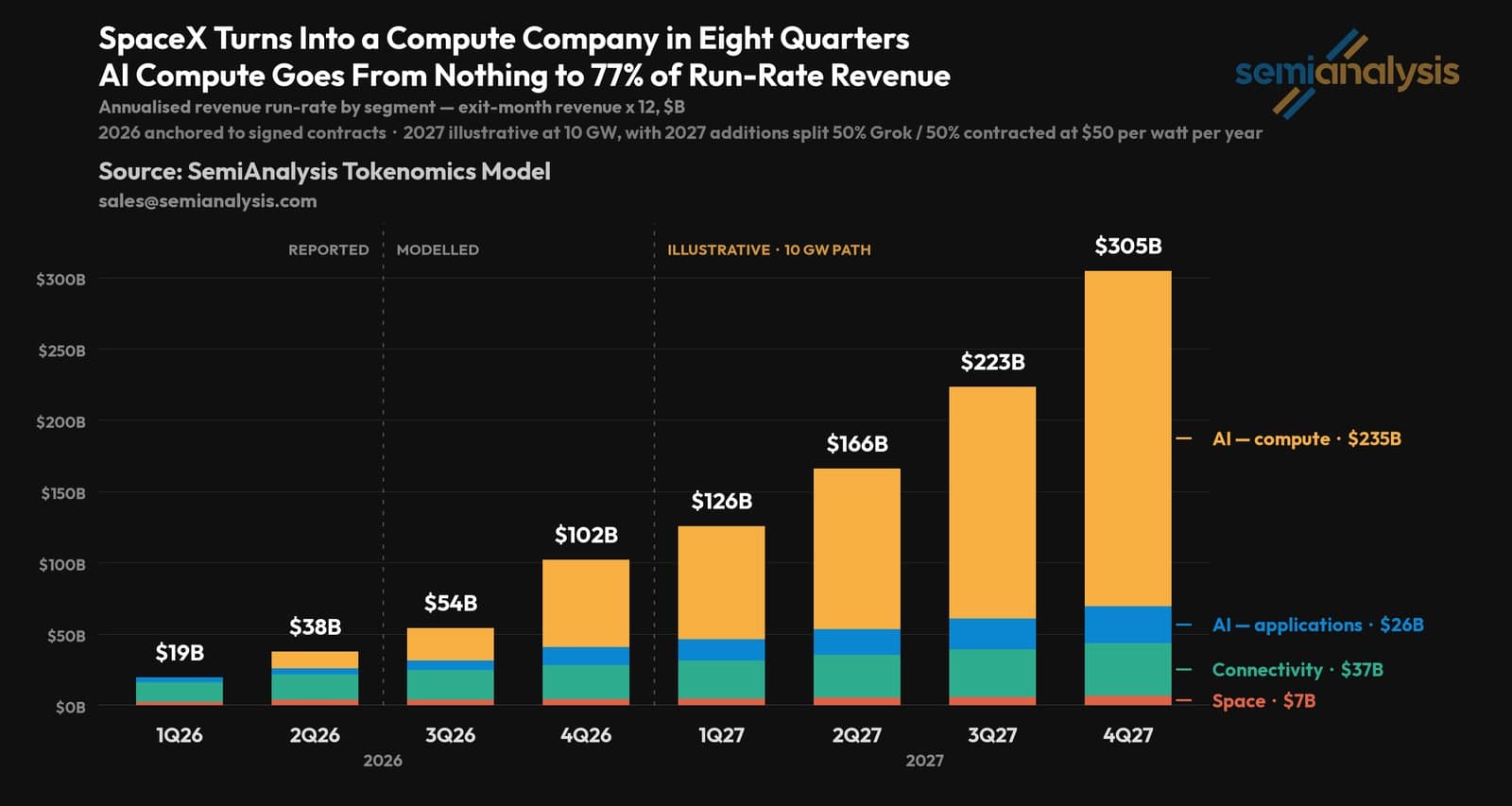
Everyone else spends two years building and earns nothing until it turns on, the snow ball starts moving later and therefore even if they were earlier than SpaceX, they will be behind soon.
Dario Amodei,Dwarkesh Patel Podcast, 13 Feb 2026:
"I could buy $1 trillion of compute that starts at the end of 2027. If my revenue is not $1 trillion dollars, if it's even $800 billion, there's no force on earth, there's no hedge on earth that could stop me from going bankrupt if I buy that much compute. Even though a part of my brain wonders if it's going to keep growing 10x, I can't buy $1 trillion a year of compute in 2027. If I'm just off by a year in that rate of growth, or if the growth rate is 5x a year instead of 10x a year, then you go bankrupt. So you end up in a world where you're supporting hundreds of billions, not trillions."
"Why haven't we signed $10 trillion of compute starting in mid-2027? First of all, it can't be produced. But second, what if the country of geniuses comes, but it comes in mid-2028 instead of mid-2027? You go bankrupt."
But if you rent the compute out, take on the risk yourself then you have higher returns (albeit maybe not higher risk adjusted returns, but never bet against Elon). There is probably a near infinite demand for intelligence, since the one willing to pay for it in the long term is the one getting ROI.
He Predicted it a while ago with this infamous post:
The crucial part is focusing on the profit, since that is what allows you to buy the next shitload of GPUs.
The scaling laws are also starting to turn in their favor, again
Grok 4.3 was shit. Grok 4.5 was a lot better. Grok 4.6 is actually good, especially on the Pareto cost frontier, but still below 5.6 Sol and Fable 5.
The cursor data, and research team, has clearly been a huge help here since their Composer 2.5 model was already on the cost efficiency frontier but now they were able to scale up compute - combining the best of both worlds.
Cursor didn't have a lot of revenue, around $3 b, but this was also because they were mostly reselling tokens (I would still argue they had a moat - best cloud agents, data on coding agents, and existing users).
Now that they have more capable in-house models though and sell mostly through API pricing, I believe model revenue can skyrocket - and don't even get me started on Grok Bot (f*cking amazing product that increased my own grok usage exponentially - since it also uses cursor cloud agents more than I ever could).
What is next and Orbital Data Centers
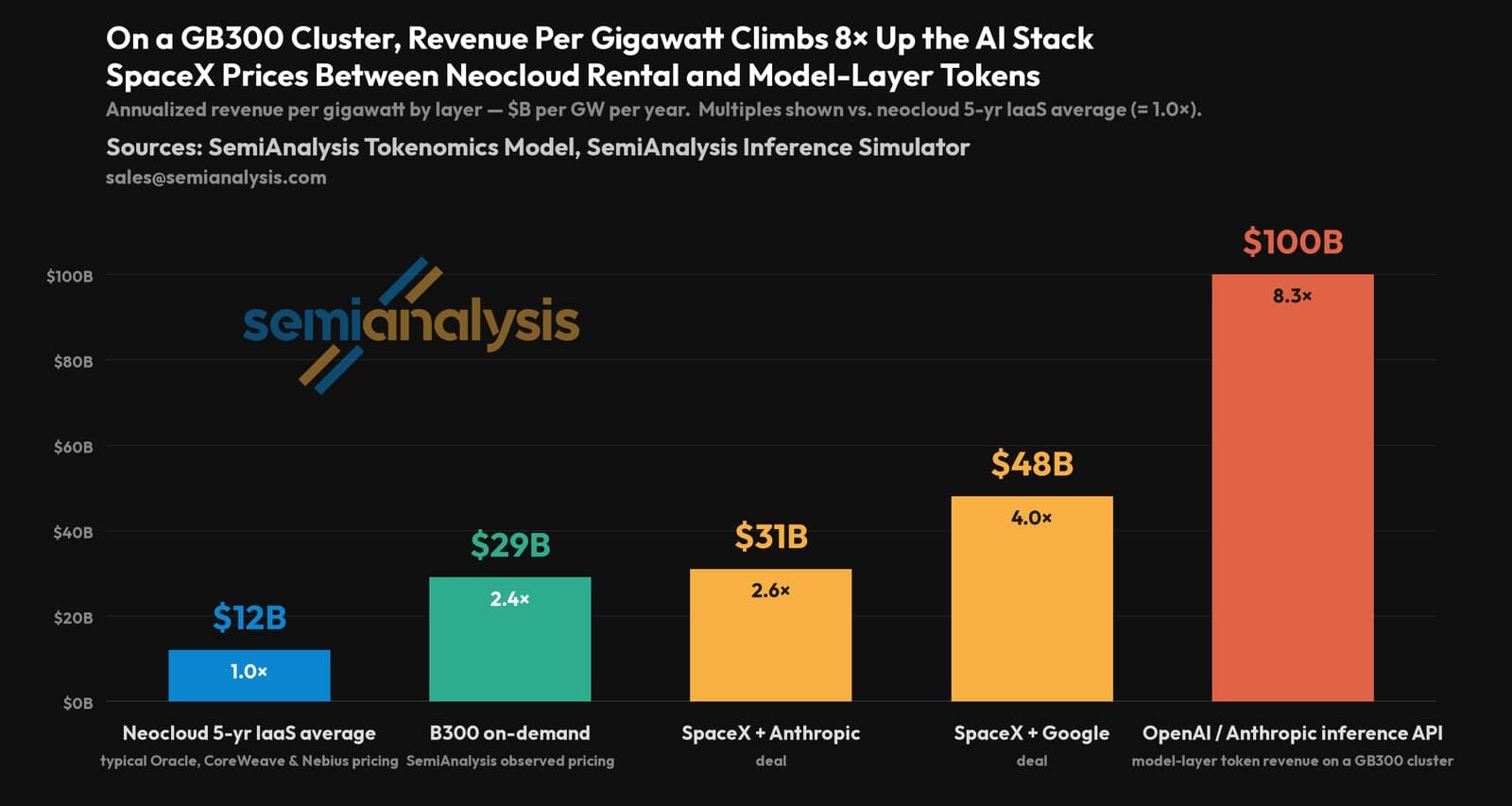
Q2 closed at 1.4 GW. They said they will have 2 GW by December. Elon's conservative add for 2027 is 6 to 8 GW. SemiAnalysis has them near 10 GW by year-end, half of it being rented out, and about $300 billion of ARR. Funded with IPO cash and the $25 billion June notes (only 5.35% and due 2031).
The bottleneck for orbital compute on Starship is still reuse. Flight 13 (24 July) put Ship 40 in the Indian Ocean in one piece. Most tiles held; some edges and seams were damaged. Elon said a tower at that landing would have caught it.
He first said the next flight would try a catch. On 20 August he moved it: first Ship catch is a few months out (need more testing since flight 13 landing burn partially failed - and they are probably still waiting on FAA approval), first reused Ship end of 2026 or early 2027. Flight 14 is tracking around mid-September: first full orbit and Starlink V3 to a real orbit, then a water landing (hopefully all will work fine).
Starship with both stages reused is aiming at $100 to $200 (Falcon 9 is minimum $1,500) per kilogram. Gavin Baker puts that launch bill at about $5 billion and chips at $35 b per gigawatt, so the space stack is roughly $40 b against $60 b per GW on Earth - and the economics of putting it in space can only get better from here (I am looking at you Optimus).
First AI satellites will hopefully launch in late 2027, then scale in 2028.
What still has to happen
The one-year payback has to keep holding as they add gigawatts, or just not increase too much (whether from renting out or from selling tokens).
Both stages of Starship have to become fully reusable and manufactured at scale, or orbit doesn't happen.
Lastly and most importantly, Elon has to keep manufacturing stuff faster than anybody else (and I'm willing to take that bet any day of the week).
You go bankrupt if the cluster does not pay you, and you have a shit product if you never scale compute. And they both go hand in hand
compounding is the name of the game, becoming the faster and bigger snowball
PS
feedback is much appreciated and would love it if you have any comments and I'll respond/answer to all